Showing posts with label Steelhead Fishing. Show all posts

9.07.2013

PERFECTION

THE DEAN RIVER 2013

Written By Deschutes Angler Guide Alex Gonsiewski

It is hard to believe that it has been a month since I looked out the window of the de Havilland Otter at the mountains of British Columbia. The flight into the Dean was the perfect bush flight. We traveled south from Smithers for 15 minutes and then hung a right and made our way west through rugged mountain passes and down river valleys until, WHAM-O, we emerged into the Fjord that is the Dean Channel. Ten minutes later we had come to rest on the Dean airstrip, little more than a dirt path cut out of the surrounding forest.

The scenery of the lower Dean is worth the price of admission.You have never steelhead fished--or perhaps been--in a more beautiful, awe inspiring place. Granite peaks, snow covered mountains, eagles, bears and dense green forests complement the sexiest of steelhead water.

When Steve Morrow dropped me off in the Cut Bank the first morning, it took me five minutes to control the shaking and clear my eyes enough to make a decent cast. Here I was standing in the Dean. No care in the world except how to swim my next cast. Pure and utter bliss.

I had heard for years that Dean steelhead are like no other steelhead in the world. The hardest fighting, rip snorting ass kicking steelhead you will ever face.  It is true. I had my drag cranked down tarpon tight and each fish removed backing from my reel as if it was free spooling. These are wild wild fish.

One quick fish story. It takes place on river right. I made my cast, stepped down and the fly dug in and started swing slow. The kind of swing were you know you are about to get lit up. Next thing I know my Kingpin reel was screaming and whack-whack-whack the backing knot was out the tip top along with an additional 75 yards of backing. As I tried to put the brakes on a fish that I believed to be a couple hundred feet downstream, my fish comes ripping out of the water fifteen feet away from me. I knew then that I had lost. One more jump and I was left mouth agape and line limp. It feels good to get your ass kicked from time to time.

The place is PERFECT. No ifs, ands or buts about it. This is a trip that I will remember and be grateful for, for the rest of my life. I was truly humbled by the immensity of the place. I only hope that someday I can return to the Dean for another shot. And that we do not destroy the fishery in the mean time.

Conservation

Anadromous fish returns are cyclical. They are dependent on so many natural variables--river conditions upon hatch, estuarine health, ocean conditions and river levels upon return. Add upon that the effects that man have on these runs and it is a surprise that any fish make it back to the river at all.  Even to places as remote as the Dean. 

There was disappointment expressed by the anglers and guides that I spoke to about the number of fish hooked this season on the Dean and the percentage that displayed net marks. Guide and fisheries major Steve Morrow informed me that the salmon gill net fishery in The Dean Channel was more intense than normal this year with boats coming from as far away as the Skeena to fish. He and many others believed that the low return was based largely on the salmon gill net fishery.  

Spending a week on the Dean with fishing that is considered below average for that watershed does not bother me. I was grateful to hook just one of these amazing fish. Nor do I believe it bothered anyone in the group. We are steelhead anglers, we understand the fishing is not always on fire. However, I am appalled when the return of steelhead is low, and the fishing tough, for man made reasons. Steelhead are by-catch in the salmon gill net fishery and the problems that we face here in the Columbia drainage are the same as they face on the Dean. Gill nets kill steelhead. Plain and simple. Those that are not killed show less vigor and are riddled with net marks that leave them susceptible to infection and . Short of removing these nets all together from the Dean channel there are other measures that can be taken. 

For more information about the measure that can be taken to reduce the effects of the gill net fishery on steelhead. Or to voice your outrage to the Canadian Government. Check out http://area8watch.wordpress.com for more information.

Get Adobe Flash player

1.05.2013

STEELHEAD TRIBUNE POLL

STEELHEAD TRIBUNE POLL:  FAVORITE WINTER STEELHEAD FLIES?

Written By Deschutes Angler Fly Shop Crew


We held our inaugural Steelhead Tribune Poll.  We think the Poll turned out fantastic!  We want to thank all of our readers whom voted! Out of the 37 readers who participated, an overwhelming majority picked MOI Fly (My Own Invention) as their Favorite Winter Steelhead Fly.  We partially expected this because if one is a Fly Fisherman, the creativity and satisfaction one gets from building, imagining and then catching a fish on a MOI Fly sometimes trumps over all others.

We don’t know how many readers would like to share their MOI Fly’s but we encourage you too so we can post the lovely, not so lovely or downright crazy MOI’s in a fun post for all viewers to see and garner inspiration from.  Please send photos (preferably .jpg / .tif / .png – sized between 800 x 800 and 1500 x 1500) to: 


Get Adobe Flash player

12.21.2012

SETTING UP YOUR SPEY ROD

THE BASICS OF SETTING UP YOUR SPEY ROD

Written By The Deschutes Angler Crew


For Fly Fishing and Spey Fishing individuals whom are entering into the world of Steelhead and Salmon Fly Fishing with a Spey Rod Outfit, or if you are looking to upgrade and maybe fine-tune your current Outfit, the below Spey Line Setup chart should answer some of the fundamental questions you may be having when it comes to the sometimes difficult question: "What should I purchase if I want to set myself up with a complete Spey Line Setup?"  

The chart outlines the two styles of getting you on the water and swinging flies with a Two-Handed Rod - Scandinavian Style and Skagit Style.  We at Deschutes Angler typically use the Scandinavian Shooting Heads in the Summer when swinging traditional wet fly patterns.  Skagit Heads are used in the Winter to pick up large Leech Patterns, Intruder Patterns, and Large Tube Flies that are used at this time of the year.

Please also note that Scandinavian Heads are to be used with Polyleaders, whereas Skagit Heads are traditionally used with Heavy Tips i.e. Type 3, Type 6. Type 8.

Contact Deschutes Angler Fly Shop

Please feel free to contact us here at the shop for any questions or recommendations for setting up your Spey Rod!  Were a full service Fly Shop with over 40 years of combined Steelhead and Trout knowledge.  We can instruct you on exactly what you will need when it comes to increasing your hook-ups and catching Steelhead, or any fish on a Two Handed Rod for that matter!


Spey Line Setup
Scandinavian & Skagit Spey Line Setup


12.18.2012

CHASING DESCHUTES STEELHEAD

TACTICS FOR CHASING LATE DESCHUTES STEELHEAD

Written By Deschutes Angler Guide Steve Light


Are There Still Steelhead In The Deschutes River?

No need to hang up the cleats just yet. The Summer Steelhead season has a little life left in her. Now’s the time to dig deep. The river is up, cold, colored and void of anglers. But the hope of chrome is still alive and kicking. For those die-hard Deschutes Steelheaders this is the time for a late Summer-Run beast. And I mean a real BEAST! No need to be at the 'Moss Hole' at 4:15 am to reserve your rock. There hasn’t been anyone around since the end of October.

What Do You Want To Bring To The Deschutes?

Don’t bring your Floating Lines and Small Wet Flies to this show. Think “dump truck”. AIRFLO’s Intermediate Compact Skagit Heads, RIO's Skagit Intermediate Head, RIO’s Heavy MOW Tips, Black and Gold Cold Medicine, 12lb Maxima Ultragreen, and a flask of Single Malt Scotch.  Alright now, let’s find a juicy tank to run this through.


Winter Steelhead Essentials
Deschutes Angler Fly Shop Late Steelhead Essentials

Where To Look For The Late Deschutes Steelhead?

Forget about the water that you fished in August. Well, not entirely anyway. Right about where you got out of the run is where you now get in. Sure it’s up to your arm pits, and 40 degrees but these are the honey spots. On top of that, you’re also going to be fishing greasy, super-soft, gushy, slow water that oooozes its way towards the Columbia River. I think I could empty my flask whilst the fly slowly finds its way.  Keep in mind that these fish lay up in this water as temperatures plummet from a spunky 56 degrees to a frosty 40. Slow and low is the theme for these late Deschutes Summer runs. The integrity of the water will also require a slower pace as you creep your way through the run. So pay close attention to how your fly reaches the bank below you.

Critical Points And Presentation

Line management is critical to the presentation for these late Deschutes Summer run Steelhead.  Lots and lots of mending and straightening.  The Deschutes Angler Guides have found that the key to sniffing out these Steelhead is to keep a direct connection to the fly so you can feel the most subtle of grabs. The typical summer take feels like a Burlington Northern hit a cow on the tracks and the late fall bruisers can sometimes feel like a kitten playing with a ball of yarn. Be patient! Wait for it ... wait ... OK, NOW!

How We Stay Warm While Catching These Late Run Steelhead

Nope, it's not August anymore so outside of different tackle, you'll need some dry, toasty warm, bad-ass winter gear from top to bottom. I don't think you can top a Merino Wool Beanie to keep your cranium lucid. Cover your torso up with Simms' new Bulkley Jacket. This GORE-TEX and Primaloft Insulation can tackle the burliest of what Mother Nature tosses your way. Throw your old crusty leaky Neoprene Waders away, you'll need to fit yourself with Simms' New redesigned G4 Pro Wader to keep the cold flowing Deschutes out. Layer up with Patagonias' Insulated Pant atop of Patagonia's Marino Wool bottoms. You can keep your tootsies warm with a pair of Simms Super Toasty Wader Socks. Since falling in the river is not in the program, keep yourself upright with Simms Felt Guide Boots and a Collapsible Wading Staff as an added insurance policy.

Stay Toasty My Friends.


11.26.2012

SINK TIP PRESENTATIONS FOR WINTER STEELHEAD - REVISITED


Preparing To Fish For Winter Steelhead?

Using Sink Tips To Catch Winter Steelhead

I have been answering a lot questions about what sink-tips you need and under what conditions to use a particular tip? Both are valid questions and the array of different sink-tips available is a bit overwhelming. If I had to simplify things I would have a Type 3, Type 6, 10' of T-14 and 12' of T-14. Most of the other tips available are, for the most part, designed for specific uses. But keep in mind that tip selection is often a subjective decision based on ones personal preferences. Out of the gate, on 99 percent of winter rivers I have fished, I inevitably start with a Type 6 sink-tip. A type 6 tip will get the fly down, in most cases, without being on the bottom, thus avoiding hanging up which drives me crazy. In addition, a type 6 can be easily adapted to different runs by simply changing the size and weight of the fly you are fishing. If the water is faster I will put on a heavier fly and so on.


Optimal Presentation Of The Swinging Fly

For the most part the depth of the fly is not as important as the speed at which the fly swings. I noticed that Marty Shepard recently posted a similar statement on his blog and he is absolutely right. In cold water, fish seem less likely to move as far laterally as they will vertically in the water column. Watch gear guys fish pink worms on the Sandy river and you will get clear picture of what I am talking about. I have been out several times swinging a run to no avail when a gear boat will pull in, usually across the river. The anglers get out pitch there pink worm, suspended 3 to 4 feet under a bobber, 10 ft. from the bank and hook 6 or 7 fish in the time it takes me to fish the run. Those fish are moving to the pink worm vertically rather then laterally. To achieve a slow swing, you need to make slow controlled mends holding the rod out over the river to get the fly to creep across the current encouraging the fish to move vertically to the fly. You do not want to have slack in the line because it will quickly belly out. Keep in mind that the surface currents are moving quicker then deeper currents. It takes a little practice but with a little work in controlling the speed of the fly you will start see results fairly quickly.

11.20.2012

PRECISION STEELHEAD FISHING

These Are The Deschutes River Spey Fishing Fundamentals

By Guide Evan Unti

It is all to easy to get stuck fishing in auto mode where you cast, mend, swing, step with little regard to how your fly is actually fishing particularly when the fishing gets tough. But auto-mode is the worst predicament to find yourself in when you are hunting for one fish a day. Tough fishing demands a higher level of concentration to ensure the fly is fished with precision and consistency from one cast to the next. Close attention to detail is what separates the angler who finds a fish or two from the one that doesn't. So what does it mean to fish with precision and consistency?

1.) Make sure you are making consistent casts where the leader turns over in a straight line everytime. If your leader lands in a pile don't think you can just mend and make everything come straight. When you are able to watch an anglers fly and swing from the bank you will quickly notice that a bad cast results in a lowsy swing where the fly only covers a fraction of the water it was intended to. When you make a bad cast, simply strip in, roll cast back downstream and make the cast again.

2.) When using a floating line make sure the cast is quartered downstream at 35 to 45 degree angle which will allow the fly to start fishing sooner and will minimize mending. Typically the fly doesn't start cutting through the water at the right speed until 35 degrees. If you have a hard time casting at steeper angles and typically cast more across it is important to not mend the line right away. Let the line drift until the fly is about at a 45 degree angle from you and then mend.

3.) Mending the line is a crucial part of setting the swing up and it needs to be done with control to maintain tension on the line. Ideally you want to make no more then one mend after the cast lifting only the part of the line that needs to be mended and moving it upstream. After you make the cast DON'T just automatically throw a huge mend. Let the line settle on the water take a good look at how the line is laid out and mend only the portion of line that needs to be mended. Sometimes you don't have to mend at all and other times you will have to mend all the way to the fly. To mend and maintain tension, lift the portion of line that needs mending and slowly move the rod tip upstream then slowly lower the rod to back down to the water. It is important to think of your leader as part of the fly line so if the fly and leader make a u-turn upstream during the cast be sure to mend all the way to the fly. If you mend only to the line-leader junction the fly will be racing across the current to catch up with the line at least through the first half of your swing.

4.)The rod tips position in relation to the fly dictates the speed and consistency the fly will swing with, so it is important to pay attention to your rod tip during the swing. After you make your mend leave the rod tip pointing across the river perpendicular to the line until the line and fly are fairly straight then slowly begin bringing the rod tip across the current. For the most part you want the rod to stay with the fly rather then leading or lagging behind the fly. Of course different river currents will dictate where you want the tip throughout the swing. If it looks like a current is going to cause the fly the stop its swing, try to anticipate the current and start leading the fly before it reaches that particular current. If a current looks like it is going to cause the fly to accelerate, again try to anticipate the current and lag behind the fly before it enters that particular current. Once the fly has passed through one of these currents return to staying with the fly through the rest of the swing.

5.) The last critical point is to let the fly swing all the way in until it is straight downstream of you. It is so easy to overlook this part of the swing and yet it can make a huge difference between having a fish-less day or a multiple fish day. Most people are fishing 15 to 20 ft. leaders on there floating line set ups and it is important to think of that leader as an extension of the fly line. In order to let the fly swing all the way in you have to give the leader time to come around. So when you see the end of your fly line come straight down stream of you wait an additional 5 to 10 seconds to allow the leader and fly catch up. I can't tell you how many fish I see missed because the angler thinks he or she as finished his or her swing and begins making another cast while a steelhead is following the fly.

If you put all of these points together and stay focused on fishing while avoiding auto-mode you will ultimately be hooking more fish on a more regular basis. It is hard to maintain this level of concentration all day so when find yourself drifting into auto-mode just take a break and pick it up after a good snooze (maybe the best part of summer steelhead fishing).


Deschutes River Steelhead
A Wonderful Deschutes River Steelhead Specimen

11.13.2012

REBIRTH OF THE SINGLE HAND ROD

Hardy Marksman Drifter - 11' 6wt

Recently we had a chance to try the new 11 ft. 6 weight Hardy Marksman Drifter Rod set up with a Wulff Ambush line and I am considering giving up my two-handed rod for Summer Steelhead Fishing. This rod is lighter then most standard 6 weight rods and casts beautifully from the leader cast to a clean 80 ft.  Now this rod is not a switch rod despite its length, it's a true single handed 6 weight and I cast it as such. I used Spey casts with a double haul to generate the line speed needed to cast 80 ft. but the rod required little to no effort to accomplish this distance. I had one of our clients cast the rod to see how it would perform in the hands of someone who doesn't spend every free moment fishing and he was jacking further then most Steelhead lies on the Deschutes River.  I have no doubt that anyone who gets a chance to try this bad boy out will see the potential.


Deschutes River Redband Trout
Future Product Of An Early Release

8.19.2012

DEAN RIVER, BRITISH COLUMBIA 2012

British Columbia's Best Steelhead Fishing

It has been just over a week since I returned from hosting a trip to the Dean River in British Columbia. The thrill of the trip has not yet worn off, and I doubt it will for months to come. My batteries have been completely recharged and I am ready for the long steelhead season on the Deschutes – which is already in full swing.

Dean River - British Colombia
Dean River - A Steelheader's Paradise

An Overview Of The Dean River, British Columbia

The Dean River is a magical place - it is a place where you might have the honor of hooking the most spectacular steelhead ever to grace the end of your fly line. It is a place where, not too many years ago, the steelhead fishing went from epic to very difficult. Anglers who had been faithfully making a pilgrimage to the Dean for dozens of years suddenly found it a challenge to hook one or two steelhead for the week. Many anglers dropped off the “Dean’s list” forfeiting their reservations for one of the few spots in a lodge, declaring “The Dean is dead!” But those who made such declarations forgot one important thing about steelhead – they are damn hard to kill off. In our backyard, the Columbia River basin, we have thrown many a wrench into the machinery that makes up the life-cycle of the steelhead.  Dams, clear cut logging on steelhead spawning tributaries, commercial netting,  industrial pollution, more dams, hatchery fish with inferior genetics commingling with wild stock, regulations which allow bait fishing and treble barbed hooks, tribal netting, overgrazing and riparian destruction, more dams yet our wild steelhead have survived. In some years, mostly due to good ocean conditions, they have even thrived. The Dean fish have obstacles to overcome too, some introduced by nature, and many introduced by man, but they have cycled through the bad times and are far from dead (as previously declared) – they are very, very much alive.


Dean River Lodge - Moose Lake Lodge - British Columbia

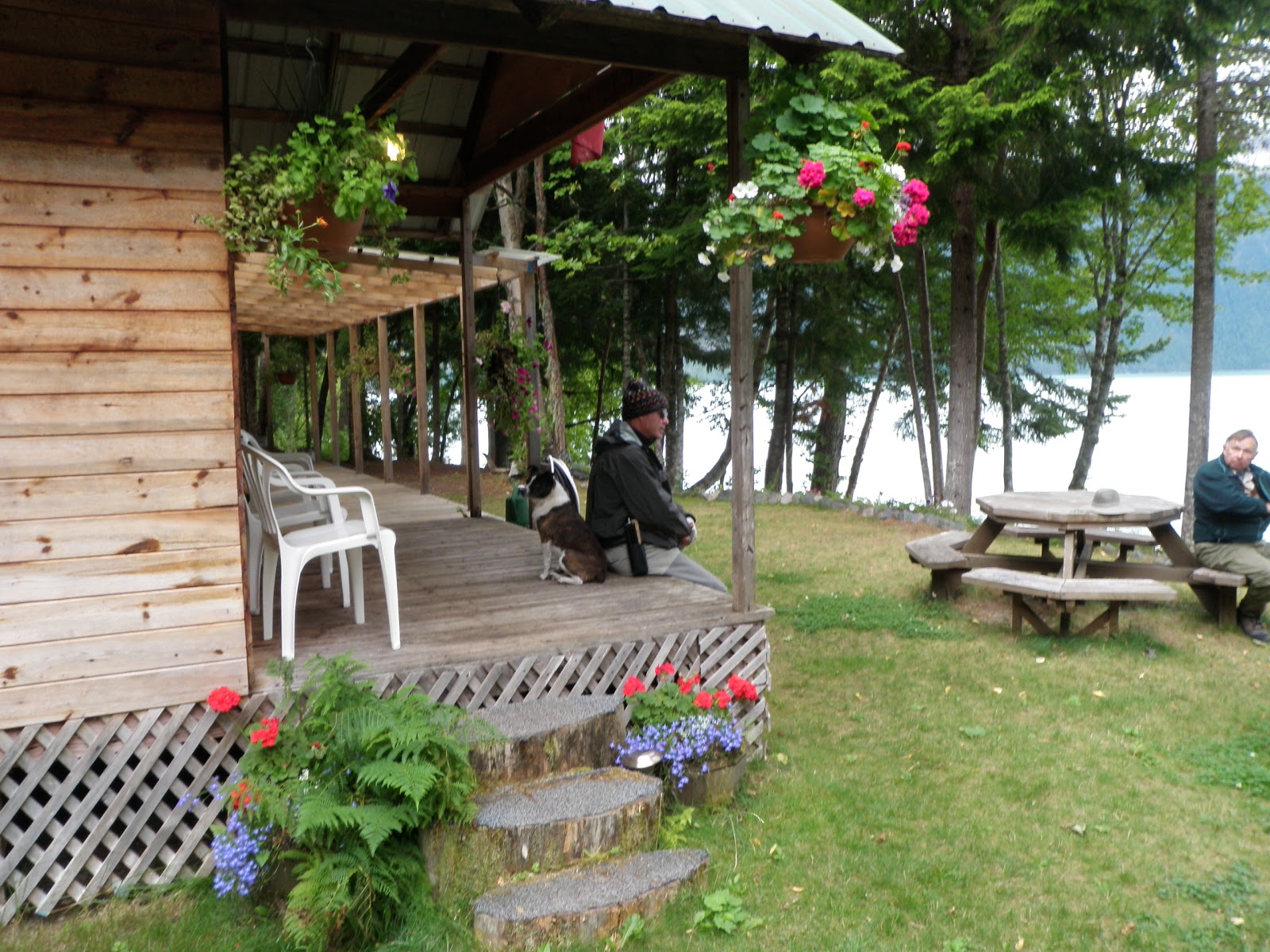
I have been fortunate to book six guided spots on the Dean for the first week of August at Blackwell’s Lodge.  We fish the lower 3 miles of the Dean, from the canyon to the confluence with saltwater, and share this stretch with only a few other anglers. The Blackwell guides, Steve Morrow and April Vokey, make their hard work seem effortless, and give us, the anglers, a fantastic experience on the water.   They are there with a camera if we want a grip and grin, but they also sense when we need some space and some time to be one with the river and the surroundings. The lodge staff, Diana and Dana (April’s sister), make all the meals memorable and the atmosphere light and happy.  Justin Blackwell entertains us in the evenings with stories of bush flying in the Canadian outback, and amazes us with his ability to fix everything from generators, to toilets, to wi-fi systems and satellite phones. The lodge and cabins sit on a perch overlooking the saltwater fiord known as the Dean River Channel, and we enjoy cool breezes and the call of the loon in the evening and early morning when we are not on the river fishing. Lodge dogs scare away stray bears that get too close to the grounds and are excellent tail-wagging escorts to and fro from the lodge to the cabins.


Blackwell's Lodge on the Dean River
Blackwell's Dean River Lodge 

Fly Fishing Conditions On The Dean River

Our week was spectacular, conditions were perfect, and the steelhead were happy.  To me, a perfect steelhead trip is one which offers each and every angler on the trip some good opportunities to hook steelhead, some steelhead on the end of the line, adrenaline surges and a feeling of helplessness on at least a couple of fish, and I always hope for everyone to have a chance to look a steelhead directly in the eye for just a moment before allowing it to continue its journey. Hooking huge numbers of fish is not part of my recipe for a perfect trip, nor is landing every fish we hook. This may sound odd to some of you, but I feel that steelhead are a special fish because they are not easy to hook. They are special because they are a fish of 1000 casts. They are special because finding one is like finding a needle in a haystack.


The banks of the Dean River
Enjoying a day on the banks of the Dean River


April Vokey - Amy Hazel
Dean River Guide April Vokey - Deschutes Angler Fly Shop owner Amy Hazel


Beautiful Dean River Steelhead
Peter Heitman's Amazing Dean River Steelhead


The Dean River Steelhead

The needles that we coaxed from the haystack were absolutely spectacular!! Peter Heitman from Colorado landed a steelhead that measured over 40” and was the largest steelhead the guide had seen landed during his season. This fish may have weighed in excess of 25 lbs. – but it was photographed and released without a scale or a tape measure. The health of the fish should always come first. I landed one on the first day that went 36” by the tape, which I was able to use while the fish rested in the current in a net. Many fish in the 12-16 lb range were brought to hand and many others gave us the fin in mid air as they cartwheeled down the river after spitting the fly, straightening the hook, or taking our tippet and fly. Everyone got their butts kicked – everyone. When hearing the disappointment in one angler’s voice about the one that got away, I said, “You didn’t come to the Dean River to LAND fish did you? I thought you came here for an ass whuppin! If you want to LAND every fish you hook then you should be fishing for Bluegill” (I mean no offense to Bluegill by bringing their names into this – you are beautiful fish, the fish  of my childhood in Minnesota, the fish that made me fall in love with sight fishing – I love you, Bluegill! 


Peter Heitman Glowing Chrome!
Bob Thacker Showing Off  A Beauty

Amy Hazel with a Dean River Steelhead
Amy Hazel of Deschutes Angler Fly Shop hooking into Dean River Steel

Dean River Steelhead
Gorgeous chrome Dean River Steelhead


There were days on the Dean where each angler in my group hooked multiple steelhead and there were days which yielded zero steelhead to some anglers, including me on day three.  I actually respect the fishery more for giving me a blank day now and then because that is, to me, a real steelhead experience – having to work for the fish you hook.


Amy Hazel with 20lbs. of Dean River Chrome
Amy Hazel with 18lbs. of Dean River Chrome

Trophy Dean River Steelhead
Amy Hazel with a Trophy Dean River Steelhead

One morning a particular spot yielded four steelhead to my flies in a matter of an hour. These were flies that I had designed for the trip, that I had tied in the dark winter with Dean dreams in my head, that had never before been swung past a steelhead, that had no names and that (by my own rule) could not be given a name until fooling a steelhead. When our guide came up river with another angler from our group, I waved him over to put that angler in my run and I sat back to watch him hook a few more out of the pool. I took photos, I walked along the river, I sat on a log, and I breathed it all in. I named a couple of my flies from that morning’s success. When I climbed into the float plane at the end of the week, I had completely recharged my batteries.

All five of my guys who fished the Dean with me last year have expressed a desire to return to the river next year. My waiting list for an open spot is eight anglers long and growing.  Making the Dean’s List could require a wait of several years, but the first steelhead you hook will make it worth the wait.