Showing posts with label Steelhead Spey Fishing. Show all posts

3.27.2013

KEEPING THE FAITH

WINTER STEELHEADING

Written By Deschutes Angler Guide Alex Gonsiewski


Staying sane as a steelhead guide is about keeping the faith. Every morning while I eat a jalapeno and cheddar cheese bagel and drink a cup of coffee I believe, no matter how yesterday went, that today is going to epic. Every time I have a client step into a run I  smell steelhead, and keep the faith. No fish, no matter, I have faith in the next run and the next.

Likewise, you have to keep the faith to be a good steelhead angler. Have faith in your fly, have faith in your swing and have faith that there is a steelhead in front of that juicy looking rock. No fish, no worries just keep fishing and keep the faith. 

Here are some photos from last week to get you juices flowing.There are still a couple weeks left in the 2013 Winter Steelhead Season. Get out there have faith and enjoy yourself. All you can do is fish good water well. Like some help know what that entails? Give us a call at Deschutes Angler Fly Shop (541)395-0995, we still have a couple openings left for the 2013 season. 

Get Adobe Flash player

2.19.2013

TIME TO PUT ON YOUR BIG BOY/GIRL WADERS

MACKS TO THE MOUTH ONE DAY FLOAT

Written By Deschutes Angler Guide Alex Gonsiewski


Marathon Steelhead Fishing

23.9 miles, 16 hours and the BEST steelhead water on the Deschutes River. This trip is not for everyone. However, for hard core anglers itching for snow belly chromers in late July and early August, these 24 miles are the place to be in Oregon. You will fish a lot of water. These are not trips with four hour afternoon naps. You might rest for an hour around lunch time, but in no time the Spey rod will be back in your hands and the line will be zinging out over the river. Full sun? No problem! There are dozens of spots on the lower river were fish love to smack wet flies under the hot summer sun. 

If you have never seen the Wild and Scenic lower canyon of the Deschutes River, you owe it to yourself to do this trip. The  geology of the lower canyon is amazing. The past 65 million years rock formations are unveiled during the float like so many layers of a cake. The wildlife is abundant. It is not uncommon to see Big Horn Sheep, Kingfishers, Mule Deer, Mink, and multiple species of Raptors. Throw in 5 class III  and several more class II rapids, and the float alone is worth the price of admission. 

Get Adobe Flash player


Hot Weather Hot Fish

There is nowhere that I rather be at this time of year. The weather is hot and the fish are even hotter.  The steelhead in the lower river in August and early September are hot, rip-snorting silver bullets. Need to check your windblown hair? Use the side of one of these fish to check out your reflection. These steelhead are fresh from the Columbia River and the Pacific Ocean and are looking to kick your ass. To make it even sweeter the fish are often in pods and finding one often means find more.

Logistics 

Your day will start about an hour before first light, meeting your guide either at the fly shop or at your hotel. Together we will enjoy the teeth-jarring drive down the access road to Macks Canyon. You will fish hard taking all day and take off the river at Heritage Landing just before dark. On our way back to Maupin, we will stop by Big Jim's for dinner - it's my favorite burger joint in The Dalles. Or, if you headed back to Portland and you want to save some time, you can pay to have your vehicle shuttled to Heritage Landing. From there you are 95 miles from Portland on I-84.

If you are new to Spey casting, come spend a day with us learning the basics of the cast the day before the float. You want to have your A game for this trip. Afternoon wind is common and being able to cast in the wind is going to allow you to maximize your fishing time and chances at fish. If you are interested in booking a day trip Macks to the Mouth give us a call at Deschutes Angler Fly Shop.  These trips are limited to late July and August and they fill up quickly.


12.21.2012

SETTING UP YOUR SPEY ROD

THE BASICS OF SETTING UP YOUR SPEY ROD

Written By The Deschutes Angler Crew


For Fly Fishing and Spey Fishing individuals whom are entering into the world of Steelhead and Salmon Fly Fishing with a Spey Rod Outfit, or if you are looking to upgrade and maybe fine-tune your current Outfit, the below Spey Line Setup chart should answer some of the fundamental questions you may be having when it comes to the sometimes difficult question: "What should I purchase if I want to set myself up with a complete Spey Line Setup?"  

The chart outlines the two styles of getting you on the water and swinging flies with a Two-Handed Rod - Scandinavian Style and Skagit Style.  We at Deschutes Angler typically use the Scandinavian Shooting Heads in the Summer when swinging traditional wet fly patterns.  Skagit Heads are used in the Winter to pick up large Leech Patterns, Intruder Patterns, and Large Tube Flies that are used at this time of the year.

Please also note that Scandinavian Heads are to be used with Polyleaders, whereas Skagit Heads are traditionally used with Heavy Tips i.e. Type 3, Type 6. Type 8.

Contact Deschutes Angler Fly Shop

Please feel free to contact us here at the shop for any questions or recommendations for setting up your Spey Rod!  Were a full service Fly Shop with over 40 years of combined Steelhead and Trout knowledge.  We can instruct you on exactly what you will need when it comes to increasing your hook-ups and catching Steelhead, or any fish on a Two Handed Rod for that matter!


Spey Line Setup
Scandinavian & Skagit Spey Line Setup


11.20.2012

PRECISION STEELHEAD FISHING

These Are The Deschutes River Spey Fishing Fundamentals

By Guide Evan Unti

It is all to easy to get stuck fishing in auto mode where you cast, mend, swing, step with little regard to how your fly is actually fishing particularly when the fishing gets tough. But auto-mode is the worst predicament to find yourself in when you are hunting for one fish a day. Tough fishing demands a higher level of concentration to ensure the fly is fished with precision and consistency from one cast to the next. Close attention to detail is what separates the angler who finds a fish or two from the one that doesn't. So what does it mean to fish with precision and consistency?

1.) Make sure you are making consistent casts where the leader turns over in a straight line everytime. If your leader lands in a pile don't think you can just mend and make everything come straight. When you are able to watch an anglers fly and swing from the bank you will quickly notice that a bad cast results in a lowsy swing where the fly only covers a fraction of the water it was intended to. When you make a bad cast, simply strip in, roll cast back downstream and make the cast again.

2.) When using a floating line make sure the cast is quartered downstream at 35 to 45 degree angle which will allow the fly to start fishing sooner and will minimize mending. Typically the fly doesn't start cutting through the water at the right speed until 35 degrees. If you have a hard time casting at steeper angles and typically cast more across it is important to not mend the line right away. Let the line drift until the fly is about at a 45 degree angle from you and then mend.

3.) Mending the line is a crucial part of setting the swing up and it needs to be done with control to maintain tension on the line. Ideally you want to make no more then one mend after the cast lifting only the part of the line that needs to be mended and moving it upstream. After you make the cast DON'T just automatically throw a huge mend. Let the line settle on the water take a good look at how the line is laid out and mend only the portion of line that needs to be mended. Sometimes you don't have to mend at all and other times you will have to mend all the way to the fly. To mend and maintain tension, lift the portion of line that needs mending and slowly move the rod tip upstream then slowly lower the rod to back down to the water. It is important to think of your leader as part of the fly line so if the fly and leader make a u-turn upstream during the cast be sure to mend all the way to the fly. If you mend only to the line-leader junction the fly will be racing across the current to catch up with the line at least through the first half of your swing.

4.)The rod tips position in relation to the fly dictates the speed and consistency the fly will swing with, so it is important to pay attention to your rod tip during the swing. After you make your mend leave the rod tip pointing across the river perpendicular to the line until the line and fly are fairly straight then slowly begin bringing the rod tip across the current. For the most part you want the rod to stay with the fly rather then leading or lagging behind the fly. Of course different river currents will dictate where you want the tip throughout the swing. If it looks like a current is going to cause the fly the stop its swing, try to anticipate the current and start leading the fly before it reaches that particular current. If a current looks like it is going to cause the fly to accelerate, again try to anticipate the current and lag behind the fly before it enters that particular current. Once the fly has passed through one of these currents return to staying with the fly through the rest of the swing.

5.) The last critical point is to let the fly swing all the way in until it is straight downstream of you. It is so easy to overlook this part of the swing and yet it can make a huge difference between having a fish-less day or a multiple fish day. Most people are fishing 15 to 20 ft. leaders on there floating line set ups and it is important to think of that leader as an extension of the fly line. In order to let the fly swing all the way in you have to give the leader time to come around. So when you see the end of your fly line come straight down stream of you wait an additional 5 to 10 seconds to allow the leader and fly catch up. I can't tell you how many fish I see missed because the angler thinks he or she as finished his or her swing and begins making another cast while a steelhead is following the fly.

If you put all of these points together and stay focused on fishing while avoiding auto-mode you will ultimately be hooking more fish on a more regular basis. It is hard to maintain this level of concentration all day so when find yourself drifting into auto-mode just take a break and pick it up after a good snooze (maybe the best part of summer steelhead fishing).


Deschutes River Steelhead
A Wonderful Deschutes River Steelhead Specimen

9.01.2012

TWO SALTS ON THE DESCHUTES

Magic Days Fishing For Steelhead On The Deschutes

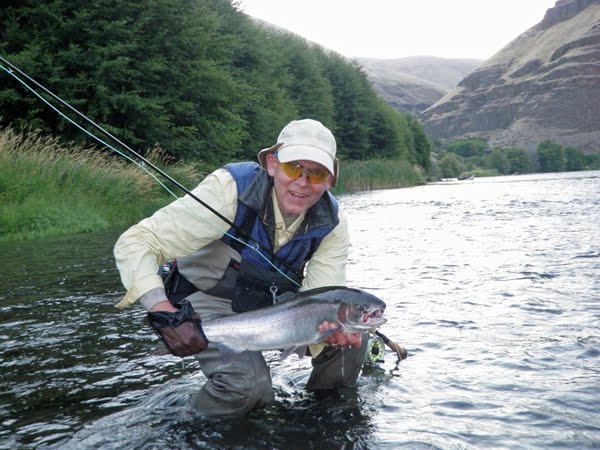
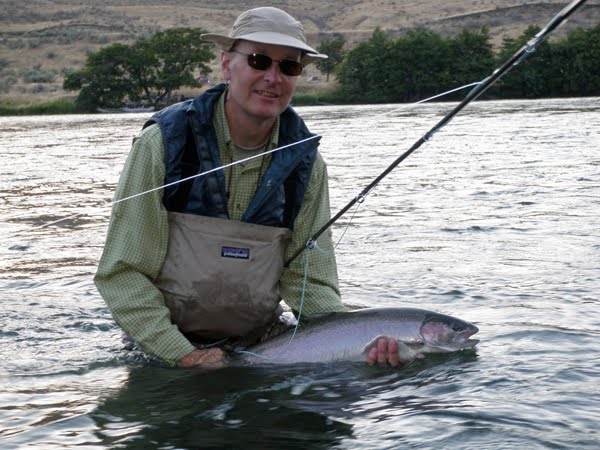
The fishing on the Deschutes has been run of the mill Steelhead-ing with a few magic days thrown in the mix. That being said the quality of fish this year has been superb. We have been seeing a lot of fish in the 10-12 lb. range and several larger. These fish are mean, taking most anglers into their backing and cartwheeling from one end of the river to other without hesitation. Some battles have gone up to 15 minutes with multiple runs into the backing after having brought the fish all the way to your feet. Hopefully this trend continues for the remainder of the season. Here are a few photos to fuel the fire. I wish there were more but these babies are hard to land.

Deschutes River Steelhead Bliss

Deschutes River Steelhead
The first for the release

 
Deschutes River Steelhead
And the second

Deschutes River Steelhead
Not the same person, but we can go with the third

Deschutes River Steelhead
And last, but not least, the fourth in the bunch.