Showing posts with label Deschutes River Steelhead Fishing. Show all posts

2.19.2013

TIME TO PUT ON YOUR BIG BOY/GIRL WADERS

MACKS TO THE MOUTH ONE DAY FLOAT

Written By Deschutes Angler Guide Alex Gonsiewski


Marathon Steelhead Fishing

23.9 miles, 16 hours and the BEST steelhead water on the Deschutes River. This trip is not for everyone. However, for hard core anglers itching for snow belly chromers in late July and early August, these 24 miles are the place to be in Oregon. You will fish a lot of water. These are not trips with four hour afternoon naps. You might rest for an hour around lunch time, but in no time the Spey rod will be back in your hands and the line will be zinging out over the river. Full sun? No problem! There are dozens of spots on the lower river were fish love to smack wet flies under the hot summer sun. 

If you have never seen the Wild and Scenic lower canyon of the Deschutes River, you owe it to yourself to do this trip. The  geology of the lower canyon is amazing. The past 65 million years rock formations are unveiled during the float like so many layers of a cake. The wildlife is abundant. It is not uncommon to see Big Horn Sheep, Kingfishers, Mule Deer, Mink, and multiple species of Raptors. Throw in 5 class III  and several more class II rapids, and the float alone is worth the price of admission. 

Get Adobe Flash player


Hot Weather Hot Fish

There is nowhere that I rather be at this time of year. The weather is hot and the fish are even hotter.  The steelhead in the lower river in August and early September are hot, rip-snorting silver bullets. Need to check your windblown hair? Use the side of one of these fish to check out your reflection. These steelhead are fresh from the Columbia River and the Pacific Ocean and are looking to kick your ass. To make it even sweeter the fish are often in pods and finding one often means find more.

Logistics 

Your day will start about an hour before first light, meeting your guide either at the fly shop or at your hotel. Together we will enjoy the teeth-jarring drive down the access road to Macks Canyon. You will fish hard taking all day and take off the river at Heritage Landing just before dark. On our way back to Maupin, we will stop by Big Jim's for dinner - it's my favorite burger joint in The Dalles. Or, if you headed back to Portland and you want to save some time, you can pay to have your vehicle shuttled to Heritage Landing. From there you are 95 miles from Portland on I-84.

If you are new to Spey casting, come spend a day with us learning the basics of the cast the day before the float. You want to have your A game for this trip. Afternoon wind is common and being able to cast in the wind is going to allow you to maximize your fishing time and chances at fish. If you are interested in booking a day trip Macks to the Mouth give us a call at Deschutes Angler Fly Shop.  These trips are limited to late July and August and they fill up quickly.


1.06.2013

FLY FISHING IN FREEZING WEATHER

HOW TO KEEP WARM FLY FISHING IN FREEZING WEATHER

Written By Deschutes Angler Guide Steve Light


What We Are Talking About

Weather conditions are a popular topic these days with global warming and all. Now that Summer is long behind us, board shorts and flip flops are for the Caribbean now. But, for those of you who ”stay-cation” and pry your home waters for its bounty, definitely understand the virtues of staying warm and dry. The Fly Fishing industry, now, finally realizes the popularity of fishing-specific winter gear as a substitute for the offerings at the local Ski Shop.


Get Adobe Flash player


The Fly Fishing In Cold Weather Scenario As Presented
Sure your Helly/Hansen works great for keeping out the cold whilst schussing about on the corduroy. However, wading into the Deschutes River in February in anticipation of a hatch of BWO’s can be a bit soggy on the Helly, especially after three hours of drizzle and chest high wading.  And if you wore your down filled parka, outside of your waders, it’s now like a “Bounty” (aka … the quicker picker upper) paper towel soaking up the river. You did, however, notice it in time to stuff it in your waders. Whew! But now, you feel a dampness, no… a stream flowing inside your waders. Now a side channel has formed in your waders because the drizzle never stopped and you gave it permission to fill up your waders via Helly run-off. The best part of it all is that your long undies and socks are made of high thread count “Egyptian Cotton”, again ... Bounty. You dash to your truck to avoid Hypothermia but, with the additional water retention, progress slows to a congressional crawl. You almost succumb to the chafing, but push through the pain. Not a day that you wish to repeat. “Top to bottom warm and dry”. This is your new mantra for Winter Fly Fishing. For those of you who are first timers at this, layering, layering, and more layering? Fickle winter conditions can often dictate your ensemble of warm and dry. So having the ability to skinny it down or fatten it up a bit is paramount to your comfort. And when you are in your comfort zone you are more likely to participate rather than wait for “nicer” weather tomorrow. Believe me, it’s always tomorrow.  Let’s fish today.

Your Fly Fishing Comfort Outline
Your poorly covered head with a well worn PBR trucker hat is cool in town but freezing ass cold on the river. In case you didn’t know this 7-10% of your body heat escapes through your uncovered head. We have a few suggestions on how to keep it in. Our two favorites are from Simms Gore-Tex Extreme Hat and the Patagonia Duckbill Hat. Slap the Simms Gore-Tex Extreme Hat on when it’s gonna rain like hell and you need serious protection. The lighter weight alternative is the Patagonia Duckbill hat. Although not waterproof, it’s very windproof and light weight. Turtle necks were cool in the Eighties along with mullets and gold chains. Not so much anymore, except in remote parts of Canada, eh? Sorry Canadians, but it’s true. It’s not as though your neck doesn't get cold it’s just that “zip neck” is all you get and it’s not enough. Enter … Buff. Not just for sun protection alone. Buffs come in warm Merino Wool. And it can be worn in 150 different ways. Might I suggest around your neck.

Base Layers And Then Some When Out Chasing Winter Steelhead

This is your foundation to build upon. Wool is a time tested classic. There just is no substitute for the warmth to weight or the feel of it on your skin (like Egyptian Cotton). There is a price to pay, however. The alternative, although relatively new, has been around long enough to take the pole position among its competitors…synthetics. Both wool and synthetic garments are hydrophobic. That’s Latin for scared of water. Cotton is hydrophilic (likes water a lot). In order for you to stay dry your gear must move water away from you. Pretty simple. The biggest advantage of synthetic is its “wash and wear” properties. Most can go several outings without getting “the funk”. And I’m not referring to George Clinton.  Wool requires a bit more upkeep and is few dollars more, but the comfort factor may outweigh the cost. Simms and Patagonia provide both types of layers. Simms offers “Down Under” Merino Wool tops and bottoms. Very clean, simple and functional. As well as a less expensive synthetic version called Wader Wick. Patagonia’s Midweight Merino Wool tops and bottoms have been a staple for Patagonia for several decades. They offer a huge selection of sizes and styles for both boys and girls! And when it gets really extreme you can supersize it up to Simms’ Guide Fleece top and bottom. No bulk and lots of warmth.

Socks And Gloves For The Winter Fly Fisherman

No doubt the body’s extremities take a beating while fly fishing in freezing temps. Finding the right gloves and socks for this type of outing can be as perplexing as choosing the right fly. While not everyone has issues wearing gloves while fishing, some do. You don’t need a glove with surgical dexterity, but you need to feel the cork in your hands and not feel like you have boxing gloves on. Here are a couple of solutions to this age old problem, Patagonia’s R Series Glove and Simms Windstopper Flex Glove. Both gloves are extremely windproof and designed for a snug fit, but only the Patagonia R glove is truly waterproof due to its closed cell neoprene shell. Either choice is a homerun. Your digits are warm and toasty now...but how 'bout your toes? Obviously you have figured out that cotton kills. Gym socks are for the gym. Like the aforementioned, wool or synthetic are your best socks. The Simms Merino Wool Wading Sock or the Patagonia Expedition Weight Merino Wool Sock come highly recommended from DAFS. However, your choice of sock may depend upon how much room you have in your boots.   If you were thinking ahead, and you bought boots one size larger than your street shoe size, then you have plenty of room to go fat and luxurious. If not…then you must be smart about this. The fastest way to cold feet may not be cold water, but a lack of  room in your boot for blood circulation. Be careful about this. Too fat of a sock can cause restriction and numbness. 


Get Adobe Flash player


Fly Fishing In A Cloak Or Cape?

There’s no such jacket that does it all in all situations. Agreed? Ideally you should have a light spring/summer foul weather jacket as well as a heavy one for fall/winter extreme weather. If you can only have one jacket, you can smartly layer underneath the Simms Guide Jacket.  Up until recently, it was pretty much unheard of to find a technical fishing jacket that was warm AND waterproof BUT did not scream, “I’m a bright red ski parka!” That is, until the introduction of the Simms Bulkley Jacket. This might be the best fly fishing winter weather jacket available today. It’s hooded, insulated with Primaloft for warmth without weight and cloaked in Gore-Tex to keep it all dry. It’s a little longer than a traditional wading jacket making it awesome for sitting in a boat not freezing your ass off.   

Goin’ To Town Before Or After The River

It's probably acceptable to stroll into the Maupin Market to pick up a breakfast burrito in your base layers or what appears to be “skivvies”, though it's probably not ideal for a beer and gizzards at the “Rainbow Tavern”. Tights might be a bit suggestive and could attract unwanted attention from the locals.  Since there are few changing rooms on the river you are relegated to what you have on under your waders. A practical solution would be to wear garments that are socially acceptable. Assuming you care. Simms and Patagonia have a couple of cool offerings for just such an occasion. It’s not just après fish wear. Simms’ Cold Weather Shirt and Cold Weather Pant are a great solution. Not only do you look like a fly fisher, but you are functioning like one as well. They are at home in your waders or out. We’re seeing this gear popping up all over the place. Raves, barn risings and bum fights. The Patagonia offering looks a bit more technical and is produced from more performance fabrics. It has a more tapered fit than the Simms so it slides in and out of the waders easily. All of these pieces are lightly lined and pure synthetic further adding to their function.

12.18.2012

CHASING DESCHUTES STEELHEAD

TACTICS FOR CHASING LATE DESCHUTES STEELHEAD

Written By Deschutes Angler Guide Steve Light


Are There Still Steelhead In The Deschutes River?

No need to hang up the cleats just yet. The Summer Steelhead season has a little life left in her. Now’s the time to dig deep. The river is up, cold, colored and void of anglers. But the hope of chrome is still alive and kicking. For those die-hard Deschutes Steelheaders this is the time for a late Summer-Run beast. And I mean a real BEAST! No need to be at the 'Moss Hole' at 4:15 am to reserve your rock. There hasn’t been anyone around since the end of October.

What Do You Want To Bring To The Deschutes?

Don’t bring your Floating Lines and Small Wet Flies to this show. Think “dump truck”. AIRFLO’s Intermediate Compact Skagit Heads, RIO's Skagit Intermediate Head, RIO’s Heavy MOW Tips, Black and Gold Cold Medicine, 12lb Maxima Ultragreen, and a flask of Single Malt Scotch.  Alright now, let’s find a juicy tank to run this through.


Winter Steelhead Essentials
Deschutes Angler Fly Shop Late Steelhead Essentials

Where To Look For The Late Deschutes Steelhead?

Forget about the water that you fished in August. Well, not entirely anyway. Right about where you got out of the run is where you now get in. Sure it’s up to your arm pits, and 40 degrees but these are the honey spots. On top of that, you’re also going to be fishing greasy, super-soft, gushy, slow water that oooozes its way towards the Columbia River. I think I could empty my flask whilst the fly slowly finds its way.  Keep in mind that these fish lay up in this water as temperatures plummet from a spunky 56 degrees to a frosty 40. Slow and low is the theme for these late Deschutes Summer runs. The integrity of the water will also require a slower pace as you creep your way through the run. So pay close attention to how your fly reaches the bank below you.

Critical Points And Presentation

Line management is critical to the presentation for these late Deschutes Summer run Steelhead.  Lots and lots of mending and straightening.  The Deschutes Angler Guides have found that the key to sniffing out these Steelhead is to keep a direct connection to the fly so you can feel the most subtle of grabs. The typical summer take feels like a Burlington Northern hit a cow on the tracks and the late fall bruisers can sometimes feel like a kitten playing with a ball of yarn. Be patient! Wait for it ... wait ... OK, NOW!

How We Stay Warm While Catching These Late Run Steelhead

Nope, it's not August anymore so outside of different tackle, you'll need some dry, toasty warm, bad-ass winter gear from top to bottom. I don't think you can top a Merino Wool Beanie to keep your cranium lucid. Cover your torso up with Simms' new Bulkley Jacket. This GORE-TEX and Primaloft Insulation can tackle the burliest of what Mother Nature tosses your way. Throw your old crusty leaky Neoprene Waders away, you'll need to fit yourself with Simms' New redesigned G4 Pro Wader to keep the cold flowing Deschutes out. Layer up with Patagonias' Insulated Pant atop of Patagonia's Marino Wool bottoms. You can keep your tootsies warm with a pair of Simms Super Toasty Wader Socks. Since falling in the river is not in the program, keep yourself upright with Simms Felt Guide Boots and a Collapsible Wading Staff as an added insurance policy.

Stay Toasty My Friends.


11.20.2012

PRECISION STEELHEAD FISHING

These Are The Deschutes River Spey Fishing Fundamentals

By Guide Evan Unti

It is all to easy to get stuck fishing in auto mode where you cast, mend, swing, step with little regard to how your fly is actually fishing particularly when the fishing gets tough. But auto-mode is the worst predicament to find yourself in when you are hunting for one fish a day. Tough fishing demands a higher level of concentration to ensure the fly is fished with precision and consistency from one cast to the next. Close attention to detail is what separates the angler who finds a fish or two from the one that doesn't. So what does it mean to fish with precision and consistency?

1.) Make sure you are making consistent casts where the leader turns over in a straight line everytime. If your leader lands in a pile don't think you can just mend and make everything come straight. When you are able to watch an anglers fly and swing from the bank you will quickly notice that a bad cast results in a lowsy swing where the fly only covers a fraction of the water it was intended to. When you make a bad cast, simply strip in, roll cast back downstream and make the cast again.

2.) When using a floating line make sure the cast is quartered downstream at 35 to 45 degree angle which will allow the fly to start fishing sooner and will minimize mending. Typically the fly doesn't start cutting through the water at the right speed until 35 degrees. If you have a hard time casting at steeper angles and typically cast more across it is important to not mend the line right away. Let the line drift until the fly is about at a 45 degree angle from you and then mend.

3.) Mending the line is a crucial part of setting the swing up and it needs to be done with control to maintain tension on the line. Ideally you want to make no more then one mend after the cast lifting only the part of the line that needs to be mended and moving it upstream. After you make the cast DON'T just automatically throw a huge mend. Let the line settle on the water take a good look at how the line is laid out and mend only the portion of line that needs to be mended. Sometimes you don't have to mend at all and other times you will have to mend all the way to the fly. To mend and maintain tension, lift the portion of line that needs mending and slowly move the rod tip upstream then slowly lower the rod to back down to the water. It is important to think of your leader as part of the fly line so if the fly and leader make a u-turn upstream during the cast be sure to mend all the way to the fly. If you mend only to the line-leader junction the fly will be racing across the current to catch up with the line at least through the first half of your swing.

4.)The rod tips position in relation to the fly dictates the speed and consistency the fly will swing with, so it is important to pay attention to your rod tip during the swing. After you make your mend leave the rod tip pointing across the river perpendicular to the line until the line and fly are fairly straight then slowly begin bringing the rod tip across the current. For the most part you want the rod to stay with the fly rather then leading or lagging behind the fly. Of course different river currents will dictate where you want the tip throughout the swing. If it looks like a current is going to cause the fly the stop its swing, try to anticipate the current and start leading the fly before it reaches that particular current. If a current looks like it is going to cause the fly to accelerate, again try to anticipate the current and lag behind the fly before it enters that particular current. Once the fly has passed through one of these currents return to staying with the fly through the rest of the swing.

5.) The last critical point is to let the fly swing all the way in until it is straight downstream of you. It is so easy to overlook this part of the swing and yet it can make a huge difference between having a fish-less day or a multiple fish day. Most people are fishing 15 to 20 ft. leaders on there floating line set ups and it is important to think of that leader as an extension of the fly line. In order to let the fly swing all the way in you have to give the leader time to come around. So when you see the end of your fly line come straight down stream of you wait an additional 5 to 10 seconds to allow the leader and fly catch up. I can't tell you how many fish I see missed because the angler thinks he or she as finished his or her swing and begins making another cast while a steelhead is following the fly.

If you put all of these points together and stay focused on fishing while avoiding auto-mode you will ultimately be hooking more fish on a more regular basis. It is hard to maintain this level of concentration all day so when find yourself drifting into auto-mode just take a break and pick it up after a good snooze (maybe the best part of summer steelhead fishing).


Deschutes River Steelhead
A Wonderful Deschutes River Steelhead Specimen

9.01.2012

TWO SALTS ON THE DESCHUTES

Magic Days Fishing For Steelhead On The Deschutes

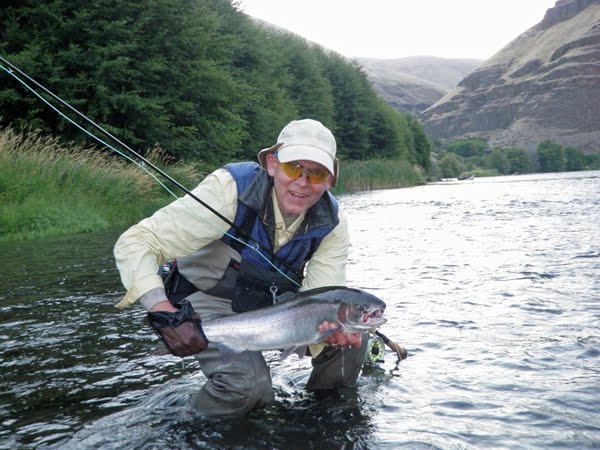
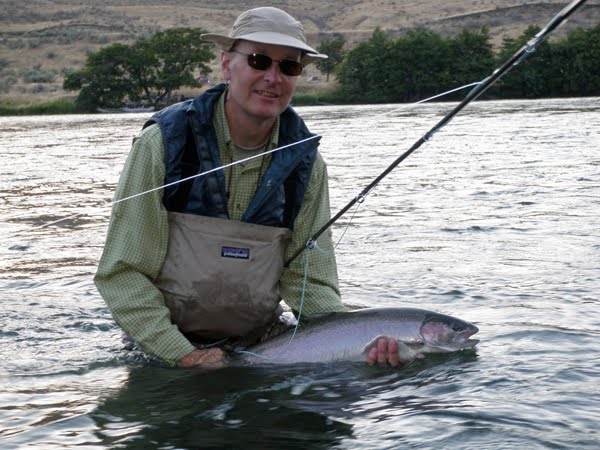
The fishing on the Deschutes has been run of the mill Steelhead-ing with a few magic days thrown in the mix. That being said the quality of fish this year has been superb. We have been seeing a lot of fish in the 10-12 lb. range and several larger. These fish are mean, taking most anglers into their backing and cartwheeling from one end of the river to other without hesitation. Some battles have gone up to 15 minutes with multiple runs into the backing after having brought the fish all the way to your feet. Hopefully this trend continues for the remainder of the season. Here are a few photos to fuel the fire. I wish there were more but these babies are hard to land.

Deschutes River Steelhead Bliss

Deschutes River Steelhead
The first for the release

 
Deschutes River Steelhead
And the second

Deschutes River Steelhead
Not the same person, but we can go with the third

Deschutes River Steelhead
And last, but not least, the fourth in the bunch.


8.02.2012

CRAZY EARLY STEELHEAD FISHING

Deschutes Steelhead
Beautiful crazy Steelhead on the Deschutes

Early Season Steelheading Can Be Spectacular on the Deschutes

By Guide Evan Unti

There is only one reason to hit the river ahead of the main run and that is simply hooking into a "crazy fish." A "crazy fish" is one that has no set agenda during the fight and makes you question your fish fighting abilities and the integrity of your equipment. If you have ever been fortunate enough to run into a fish of this nature than you know that the addiction grows with each encounter. Most of these "crazy fish" I have run into I have not landed because at no point in the fight did I ever feel I had control, I was at the mercy of the fish.

Yesterday I ran into one of these fish and to date, it was the best one I have encountered on any river. The take was like that of a mid-september hatchery fish, light like a blade of grass brushing along the fly. Initially I thought that is was just some debris but I let the loop slide through my fingers since I hadn't had a touch in awhile. The line came tight to the reel and just stopped. Literally nothing happened like hanging up on a rock. I decided to jerk up on the road because I was now thoroughly convinced I had snagged up. In the blink of an eye, as I raised the rod tip, my line took off into the backing. "Holy &$#@." I am looking down stream trying to decipher where the hell this fish was. Out of the corner of my eye I see some splashing on the far side of the river. I turn my head just in time to see this leviathon jump 5 feet out of the water. It took a second before I realized that this was my fish. I panic and start reeling like a mad dog trying to catch up to the fish. Within seconds it begins launching out of the water a hundred yards downstream of me. "What the hell is this fish doing" I think as line starts peeling off the reel again. At this poing my fly line must have looked like Zorro's signature Z in the water. I didn't know if I should reel or just hang tight. Finally I start cranking again and low and behold the fish is now way up river and still on the others side and begins cartwheeling back down stream yet again. I know this fish is big and I so badly want to see it up close, so I start putting the wood to it in a feeble attempt to gain control and in one last F-you it bombs out of the water and I see the fly shoot out of its mouth and come hurling back at me. A string of curse words promptly follow, echoing off the canyon walls.

Once I regained composure I noticed how badly my hands were shaking. "Man that was awesome" I scream. That fish was impressive and the reason that year after year I pursue these amazing creatures to just experience that shaking in the hands that lets me know I still love this sport. If you haven't hooked a "crazy fish" start scheduling some early season time and be ready for the shakes.