Showing posts with label Caddis. Show all posts

6.05.2016

FISHING LITTLE TEENY TINY FLIES

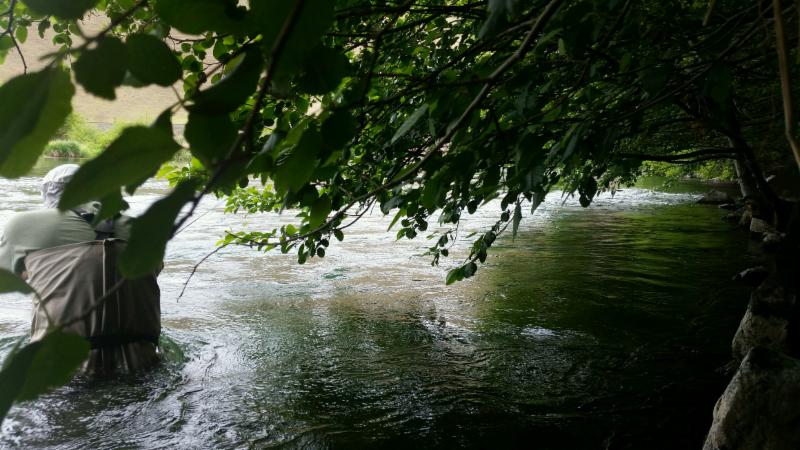
Lift, lift, lift, lift... My voice grows hoarse after a day of spent caddis fishing in the tree lines of the Deschutes River. Did you see that fish sip your fly? Haven't seen my fly today. Okay then. We have to figure out a program so that when I'm not on your shoulder whispering in your ear to lift, you can hook these sippers.


When you are fishing spent insects, primarily caddis in the summer months, it is very important that you can lock on to your fly in a target rich environment. Most trout will give you one shot. You miss him, it's over. In order to even get the fish to look at your fly it has to be matching the source as well as laced up with 6X. That's right, 6X. These fish are laying up in water that has a high surface tension ...glassy. Usually under the cover of shade. I know, I work for a fly shop that sells flies. 6X typically means more flies left in the tree branches. True, but without 6X you are diminishing your chances significantly. These trout have a bit more time to scrutinize your imitation and if we are representing dead caddis, then we need to take into consideration that tippet diameter will be noticed. So, can you use 5X fluorocarbon instead of standard mono? No. Fluorocarbon's advantages are best suited for subsurface fishing. Both will displace the same amount of water and be just as visible to the suspecting eye of the trout. So, what is the answer short of a new prescription where I bring my fly box in to the optometrist to use in place of the standard eye chart? Two flies! Oh great I loose two at a time. Great advise from a fly shop employee. It gets better! Just like a dry-dropper combination, you substitute in that size 20 caddis behind a size 16 para something or another. Don't put that size 20 behind a chubby. At least the size 16 parachute won't offend anyone. Use a shorter tapered leader. This is where a 7 1/2 foot 6X tapered leader works wonderfully. These aren't big open casting situations. A typical cast uses about a rods length in fly line and generates just enough energy to turn over a shorter leader in confined spaces. The rule of thumb on how far back should I hang the second dry fly is the approximate height of the overhanging obstruction. If the branches are two feet then give yourself two feet between them. Any longer and you will be buying more flies. Don't expect that the parachute is going to act like a strike indicator. This is only used to give you an idea where the lil'guy is. If you see a nose tip up...lift.

7.03.2015

NO TROUT RISING?

We hear it every single day at the counter here at DAFS:

Dude..."Where do you keep the bead heads?" 
Clerk..."Have you been dry fly fishing?" 
Dude..."Nope, no fish rising." 

Look, this isn't merry old England where gentleman only fish to rising trout. We are capitalistic pigs wanting to capitalize. You know where they hang out...right? If you wait to see fish rising, you had better bring an e-book and a flask cause you might be a while. Dry fly fishing, contrary to popular thought, occurs all day long. Whaaaaat? TROUT MUST EAT TO SURVIVE! Pretty basic logic. So, what do you put on to convince a non-rising trout to rise? Now THAT question beats the hell out of "where do you keep your bead heads?" Here's the short answer, in the early mornings be ready to fish mayfly spinners the moment the sun greets the water. These are quiet moments when the fish yawn and rub the sleep from their eyes. I'm sure you've seen the long tails and delicate flights of mayflies in their final cycle of life. As they die on the water their bodies gently glide across the surface of the river and get washed into the foam lines that flow along the edges of the river. Foam is HOME and exactly where the trout eat breakfast. The rises are subtle...if you think you saw something crease the surface...you did. Now the sun is blanketing the canyon and the breeze is rustling the Alders. Last night there was a blanket hatch of caddis flies, and the ovipositors (egg layers) are now at their final resting places in the trees and bushes along the banks. The breeze moves the branches and the Alders deposit the dead into the river like a giant "Pez" dispenser. Again, if you thought you saw something...you did. If you want to catch a trout on a dry fly then commit to the task! Sure, these fish are in tough spots. Under the lowest of the branches, hiding in the foam lines along the bank, under the outreaching tall grass, the places where most anglers refuse to fish. There's poison oak, blackberries, snakes, and no trail! These places are the home to the largest trout in the river. If it has a trail, well used, move on. 

6.09.2012

FISHING DRY FLIES ON THE DESCHUTES

Fishing Dry Flies For Redside Trout On The Deschutes River

It has been brought to my attention several times in the shop that we are always stressing the dry fly fishing and the hatches, yet lots of anglers say they never see anything feeding on the surface – so they stick with nymph fishing. Fair enough, you can certainly catch trout by fishing a nymph, you will also certainly lose a lot of flies fishing in this manner (good for fly sales), but you should know that the Deschutes can offer you a lot more than a day of standing in riffle water watching that little floating ball of plastic.

Deschutes Redside (Redband) Trout are programmed to look up, they want to take surface flies, but they are also wary creatures who do everything they can to avoid predation by staying in safe habitats and feeding carefully without creating a disturbance on the water. To fish a dry fly on the Deschutes you must know what type of habitat to look for and you must also approach the fish like a predator. How do you know this habitat? Well, one way to learn is to hire a professional guide who specializes in fishing dry flies successfully.

If you hire a fly fishing guide for the day, you should try to learn from that guide what he or she looks for in reading the water and finding trout willing to feed on dry flies. The guide should be happy to share with you what elements make for good trout holding water. Learning that will give you the key to finding good water next time you fish the Deschutes without a guide. After your day float or evening hatch float or (better yet) multi-day camp float, you should be able to go to any trout river in the world and use the same strategies you learned during your guided trip.

What We All Wait For


How Do We Fish For Deschutes River Redside Trout? 

Not every guide on the Deschutes prefers fishing dry flies with their clients. It is hard work to guide in this manner, and far easier to rig clients with a thingamabobber and a few nymphs. Just as there are guides who don't like to dry fly fish, there are also anglers who don't want to work as hard as is required to access the trout that eat dries. The fish most eager to take a dry fly are often in what we have coined "jungle water" which means steep banks, lots of trees, brush, poison oak, blackberries, etc. Thanks to a rule on the Deschutes in which you cannot fish from a boat or any floating device, it takes some effort to position yourself in the best dry fly water - and not everyone is up for that.

Dry fly fishing is not for everyone - but it is the reason that I fly fish rather than using other methods. There is no other way of fishing where you are so in tune to the behavior of the trout and which requires a fairly extensive knowledge of nature's food offerings in order to be successful. You must know what the trout want to eat, and you must match that menu or you will face rejection from your finned quarry. To make it even harder, there are times when the menu calls for bugs so small that you can barely tie them on the leader nor can you find them once you cast them upon the water. It's no big secret that anglers love the salmonfly hatch because they can SEE the gosh darn bugs that they are fishing. Most of the year, to be successful with a dry, you have to have eagle sharp eyes and lightning fast reflexes.

Casting And Presentation Of Dry Flies

Casting accurately is very important when fishing a dry. To become a good accurate caster in all conditions requires patience and practice. For years I practiced in my back yard or in a local park, casting a small puff of yarn to various targets until I could hit the target on the first or second attempt. That way, when I got to the river and found a rising fish, I was able to put the fly where I wanted it to go on the very first try. Remember, trout are spooky. If it takes 8 attempts to get the fly into the feeding zone, there is a very good chance that the 2nd, 5th or 6th attempt spooked the trout. Practice will benefit you greatly when you finally have real river time.

If the price of a guide trip is out of the question, then take the time to ask questions at your local fly shop. The guys behind the counter should be friendly and willing to help you learn the water types that are most productive for dry fly fishing. You are not asking them to reveal their secret fishing spots, you merely want to glean some key pieces of information to help you know what to look for when you are on the water's edge. If the fly shop is not helpful, find another fly shop. If you are headed to a destination to fish, it is always wise to wait until you get to the local fly shop to find out what flies have been most productive.

Stop by Deschutes Angler Fly Shop any time and we will be happy to talk to you at length about fishing a dry fly on the Deschutes.